24 January 2021

My legs have never been warmer

When I first saw the pattern for my 1970s detachable-sleeve sweater, I thought it was both ingenious and a little ridiculous. Now that I have actually made it, I can confirm that it is indeed extremely silly. But I also really like it. It's a well-designed, quick, and easy knit, with a fun gimmick that actually works. This might be the most wearable decade sweater yet.

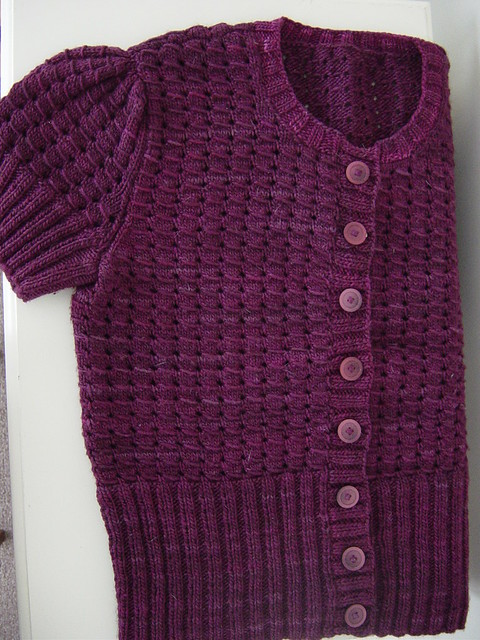
The cardigan is certainly very cozy and easy to wear. The Lopi I used for it is lofty, light, and warm and the "butterfly" cap sleeves are just over-the-top enough to be fun without reaching into impracticality. The detachable sleeves actually function much better than I'd imagined: the ribbing keeps them snug on my arms and also stretches enough to fit my legs. 

It's still weird, though. And I laughed when I put the sleeves on my legs. But, it's not a terrible look, right?! It could probably benefit from better styling, but it was really cold and windy when we took these pictures, so I was only willing to go so far for fashion.

The legwarmers are an unusual shape because you knit them as normal sleeves, so they have a fairly substantial sleeve cap, which helps them stay on your arms. It's a little more challenging to figure out how to make them look good on your legs. Pull them all the way up and you have a taller front than back. Scrunch them down and they get pretty bulky. You can see the issue here.

Initially, I had thought that the sweater was pretty timeless in its design (legwarmers aside), but when I put it on, I was surprised to see how tunic-like it was. That definitely feels like a '70s look to me. I'm glad this ultimately looks like its decade. After all, that's what this project is about!

In the end, I know I'll wear the cardigan a lot. I may often wear it with sleeves. I will likely not wear the legwarmers, but I will always enjoy the possibility that I could, if I wanted to.

Specs
Yarn: Ístex Álafosslopi
Amounts: 7 balls (687 g)
Needles: size 10.5
Started: 1 January 2021
Finished: 18 January 2021


18 January 2021

Whoosh

Happy new year!

Unsurprisingly, 2020 flew by with no entries and no progress on this project. Once the reality of the pandemic and its implications and imperatives set in, I was seized with the urge to knit small projects from my stash and send them to friends. So, I made several pairs of Svartifoss Mittens, which are fabulous for using up sock yarn remainders and odds and ends of worsted, and a few hats and scarves. I had visions of using up all of the stray balls of worsted in my possession, but didn't quite get that far before I shifted focus and started working on finger-gauge colorwork projects, also sticking solely to stash yarn. I made an Ebba and an Oa, which I love. I also made a deliciously soft and warm version of Katie's Kep, the Shetland Wool Week pattern, in hand-dyed and -spun Shetland wool. I was lucky to reserve a kit from Shetland Handspun in time. It was such a treat to knit and is an absolute comfort to wear. I haven't posted it on Ravelry yet because it has spent most of the winter on my head. 

And then, when summer really arrived, I didn't finish a thing for months. I cast on several projects and they all just languished. Understandable, really. Knitting just had to take a backseat to everything happening in our lives and in the country at large. Most of the time, I find knitting a very therapeutic activity, but this summer and fall it felt like planning, starting, and completing a project was just more than I could to take on.

I could feel my motivation creeping back in late fall, when I decided that I wanted to knit something for each member of my immediate family for Christmas. I ripped out a half-completed scarf that wasn't inspiring me anymore and repurposed the lovely Quince Piper into a Doyle shawl for my mom. I grabbed some fun sock yarn (the always satisfying Regia Pairfect and a surprisingly bright ball of Berroco Sox) for socks for my dad and brother. Finally, I had a fun fling with Fair Isle gloves, making a pair of Bosie Gloves of myself and a pair of Tveir Gloves for my sister-in-law. I had always assumed the fingers would be a fiddly pain to knit, but I really enjoyed making both of these pairs. They are wonderful to wear, too; I just love seeing all that color on my hands on a gray winter day. 

At some point among all of this fall productivity, my mother-in-law cleared out some of her knitting stash and dropped off some pattern books for me to look at and pass along to other knitters. In the pile was this volume of Ladies' Home Journal Needle & Craft from Spring/Summer 1978.

It's a very strange issue, full of knits and crafts themed around Ancient Egyptian art and artifacts, no doubt due to the blockbuster exhibition of King Tut's treasures traveling the US at the time (further reading on the exhibition and its impact here at the NEH). King Tut's pop cultural predominance worked its way into pretty much everything in the issue, from a lotus-flower-themed wedding dress (which really looks more like a nightgown to me) to an ultrasuede bikini adorned with embroidered motifs.

But, tucked in at the back of the issue were a couple of sweaters that seemed to be off-theme. They looked like ordinary garments that, with their bulky yarn and generous gauge, could be easily knit by knitters of all experience levels. I didn't really think much of them...

Then I read the caption: Ice cream colors ravish the eye in two easy knits. Del Feldman's delicious butterfly jacket has detachable sleeves that double as legwarmers! In Reynold's lush wool "Lopi" yarn.

And there it was: SLEEVES THAT DOUBLE AS LEGWARMERS. How could I resist?! So, this is my 1970s sweater. For the first time in this project, I've been able to source the actual yarn called for in the pattern. With Lopi at three stitches per inch, I expect this to be a pretty quick knit.

I was fascinated to learn a little more about the designer, Del Pitt Feldman. She passed away in January 2020 and her obituary in the New York Times is so rich in detail and surprising facts. I had no idea about her impact before this. She was quite a revolutionary designer who pushed crochet in new directions with her studio/shop in New York, which was open from 1965 into the 1980s and which boasted clients like Janis Joplin, Jimi Hendrix, Cher, and Andy Warhol. Obviously, based on the sweater above, she was incredibly inventive in knitting, too. I've never seen another sweater like this one.


21 September 2019

Mohair, No Problem

I have completed my little puffy cloud of mohair! It's as light as air and surprisingly warm, despite being a fairly loose gauge. Gotta let that fiber halo bloom.

As a refresher, this is my 1960s project from the 1962 Mohair Hand Knits booklet published by Bear Brand/Fleisher Yarns.


This is the first time I've knit an entire project solely out of mohair and it was rather delightful. The particular mohair I used was a bit of a mystery. It came as a bag of three balls from GreaterGood.com (a gift from a coworker) with minimal label information, but it turned out to be rather magical as the entire sweater took 1.15 balls. I just kept pulling and pulling and the ball seemed to take forever to get smaller.

The knitting itself was extremely straightforward as this is knit from the lower back edge up over the shoulders, with built-in increases for the sleeves. The sleeve cuffs are picked up, knit on, and folded over and then the collar is knit separately and sewn in place. The only other seaming is along the sides, so it's pretty quick to finish. Because mohair can be so sticky and fluffy, I definitely recommend using a smooth yarn for seaming. I had some neutral sock yarn that worked beautifully. 


I stuck close to the original pattern measurements and achieved the very cropped jacket look shown on the model. I probably wouldn't wear this with pants, but it's ideal over a dress (as it's styled in the pattern booklet) and makes for a very cozy layer. We took these pictures on a warm September day and I quickly got too hot in the sun! It would be perfect for an evening outside or as a way to winterize a summery dress.


Before I committed to this yarn, I knit a swatch (of course) and tried it out against my skin to make sure it wouldn't feel too itchy. It's not the softest mohair I've encountered, but it felt fine in the swatch and, now, as a complete sweater.

All in all, this was a great summer knit: lightweight, easy, and fairly quick. Plus, I had perfect buttons in my stash!


Specs
Yarn: GreaterGood.com Mohair Wool Yarn
Amounts: 1.15 balls (115 grams/660 yards)
Needles: size 4 and 5
Started: 8 June 2019
Finished: 15 September 2019

08 June 2019

Finally ready

I think I'm finally ready to start thinking about my next decade: the 1960s.

After the 1950s dress ordeal, I had to take a little break. I was thrilled to finish the dress and delighted with the outcome, but...whew...did it ever sap my knitting energy. I made a few smallish things over the winter and early spring: an extremely ugly pair of socks (not pictured...never to be pictured), a cute sweater for my cute nephew, a start on a sweater for Sam, and the most utterly satisfying Fair Isle hat. Finishing the hat in four days, after watching the colors build and play against one another and constantly thinking "just one more round," made me miss knitting it after it was done, which in turn helped to renew my creative spark.

And so today, I found myself with an idle hour or two and decided to page through a pile of duplicate pattern books that I'd separated from my collection with the idea that I might find someone else who wanted them. There's quite a few 1960s booklets in that pile. One is focused on Aran knits, one is for kids, one is an instructional booklet, and one is full of "Mohair Hand Knits."


The booklet was published by Bernhard Ulmann in 1962 and is clearly designed to be a vehicle for Fleisher's or Bear Brand Supra Mohair. Some patterns call for this yarn to be held double with a conventional sheep's wool, while others use only mohair. The cover design intrigued me, especially the model on the left with the oversized cables and collar. I kind of like it, though it's a little chunky for my personal taste. It's definitely wearable today. The red-on-pink sweater on the right is maybe a little less timeless, especially with that super close 1960s neckline, but the bold color choice is certainly eye-catching (maybe also eye-watering). Inside, there are a few more cardigans, a men's pullover, a hoodie, a matching shell and skirt, a jacket, a dress, and a massive, oversized, full-length, buttoned housecoat/dress/jacket combo thingy with pockets. In pink mohair and bulky wool. Really. It's wild.

Apologies for the blurry photo. My camera clearly couldn't handle the combination of the hot pink dress against my red couch. Pink and red again just like the cover. It's a theme.
I'm certainly not going to make that. Nor am I going to tackle another dress (plus, I already have a mohair dress of the full-body variety). But then I came across this design on the left below. That's something I could see working with my wardrobe. It would be good for work. It's fairly low commitment with the short sleeves and cropped length. It's knit in one piece from the back up over the shoulders. Plus, I remembered that I have six balls of pure mohair in my stash, just waiting for a classic 1960s mohair project like this. It seemed like it was meant to be.


I have three balls of black and three balls of white mohair. It's a bit of a mystery yarn as there's no suggested gauge or other information on the label. It feels a little thin compared to other mohairs in my collection, which, admittedly, is not many. The gauge for the pattern is 5 stitches per inch. Since it's mohair, it's a fairly loose knit to allow the yarn to bloom. I'll play around with my yarn to see what might work. I appear to have plenty of yarn (there's 570 yards in each ball), so I'll certainly experiment with holding two stands together as I have a sneaking suspicion that my mohair is lighter than the Supra Mohair specified in the pattern. I could even try one strand of black and one strand of white, which might be kind of cool. We'll see. 

It all seems like a no-brainer, surely. I like the pattern, I have the yarn. I'm not crazy to contemplate knitting a 100% mohair garment as we head into summer...right?

27 January 2019

IT IS DONE.


At long last, my 1959 Vogue Knitting dress is finished!! There haven't been many other projects whose completion has brought me so much relief and joy. I honestly thought this one might be the straw that broke the camel's back and derailed me from my century project and languished forever as an unfinished object, but I made it. It was definitely a slog. At the end, though, I have to say that I am pretty pleased with how it all turned out. It was such fun to put it all together today and try it on.

I started this dress back on 25 August 2017. It was finished on 27 January 2019. Let's see if I can remember enough to recap some of my process!

I chose the pattern from the Fall/Winter 1959 issue of Vogue Knitting magazine with the idea of challenging myself to a bigger knit. I located some black wool crepe yarn from Made in America Yarns and ordered 4 cones, figuring that I would need to work with a double strand to get gauge. I experimented with different needle sizes and eventually settled on a size 4, which gave me a suitable gauge: 13 sts is about 2" wide and one full 6-row pattern repeat is about .75" high.


I chose the lacy black dress on the left!
I made the pattern's size 14, casting on 243 sts for each half of the skirt. I opted for 150 rows to get to about 20" in length so that the dress would be about knee-length on me. That's a little shorter than the recommended 27", which I think would have been a bit too long for me. This part of the process was very slow going. The pattern was easy to memorize once established, but, boy did it ever take forever. The skirt is knitted in front and back sections and then seamed together. Once I sewed the first seam, it became really clear that I had A LOT of knitted fabric to deal with. Here's the skirt laid out on our futon!


The top was a little easier to tackle. I again selected the size 14 specifications, but added a few inches to the body length (10" total). I found it very hard to manage increasing and decreasing within the pattern on the back, so I decided not to add any shaping to the lower front. I also opted to lengthen the the armholes slightly. For the sleeves, I went for the largest size so that they would fit into my slightly expanded armholes. Weirdly, there are no conventional shoulders on this top. It's really just a wide, straight neckline that connects directly to the sleeves. It was a little fiddly to put together, but the fit was just right when I finished.

The black lace was super hard to photograph!

I made a few modifications on the finishing. I did two rows of single crochet around the neckline, which was just enough to pull it together and finish the raw edges. The pattern recommends adding single crochet to the sleeves as well, but I really liked the pretty scalloped edge, so I decided not to straighten them out with the crochet border. I did add several rows of crochet to the waist on the skirt to help bring it in closer to my waist size. Since it was still so voluminous, though, I decided not to attach it to the top. I know that means it's technically not a dress, but I do think the two pieces will be more versatile as separates. Going back to the skirt, I thought I'd go with a gathered waist instead of the elastic-and-zipper waist in the pattern. Honestly, after I did a fair bit of crochet on the waistband, I just ran a sturdy cotton tape through the holes in the crochet and made it a drawstring waist. I knew this would all be hidden under the belt. It works just fine.

With photographer Sam's apologies for my cropped head!
I put it all together this morning, along with a wide black belt from my closet. At first, I wasn't sure about the skirt. It just seemed a bit...bulky. And then I realized what it needed. A PETTICOAT. And that was it! That gave the skirt some body and structure and made it so much more fun to wear. And what a great '50s silhouette! I did my best to recreate the model's pose from the original magazine, too. Arthur the Dog joined in on the fun!


I'm really pleased with the way this turned out. And that's a major relief considering just how much knitting went into it. I'm looking forward to wearing this out and about sometime soon. Stay tuned for my foray into '60s knitting next. It's probably not going to be a dress.

Specs
Yarn: Made in America Yarns' Wool Crepe in black
Amounts: about 3 cones total (I held two strands together)
Needles: size 3
Hook: size E
Started: 25 August 2017
Finished: 27 January 2019

21 March 2018

Still knitting the dress...


My last post was in October 2017. In the time between then and now, I've managed to start and get several inches into the 1950s dress I selected for my next knit. And then I hit the pause button and stepped away for some projects that take precedence: gifts and special requested items for some of my favorite (and very knit-worthy) people.

I made my brother a sweater for Christmas, hoping that it would be easier and nicer to wear than the heavy, oversized, and just plain overwhelming one I made for him 10+ years ago. I think I did better this time. The pattern was a simple top-down raglan (from this sweater calculator) in beautifully soft and rustic Peace Fleece worsted in the "Father's Grey" colorway. It went on immediately after being unwrapped, so I think it was a hit.

Since we had a supremely cold and wintry December and early January, I was craving a warm thing to wear in the house all the time, so I picked up the souvenir yarn I bought last spring during our trip to Vancouver and Victoria, BC. The two skeins of Hinterland "Range" were just begging to be worked into a squishy, warm, high-contrast brioche cowl, which is what they became. I used Purl Soho's pattern here. So satisfying.

I also made a soft hat and a pair of socks for my husband, who has been wanting such things for years. The hat, knit in Malabrigo worsted, replaces a slightly scratchy one made with Lopi several years ago. The socks are the first of their kind in his wardrobe. I had resisted making him socks for a long time because...well...because my feet are small and that means socks are a quick and easy project. Plus, I like them in bright colors and unusual patterns But, socks for Sam would be a very different project: no fun colors or crazy patterns and leg and foot would both need to be significantly larger than I usually knit. But, he found a nice pattern (Athos by Caoua Coffee) and I had some suitable yarn, so I jumped it. And they're really nice. The pattern was fun and simple without being boring and they really didn't take much longer than socks for me.

After those fun breaks, I'm back into the 1950s dress. One half of the skirt is now done and I am plugging away on the other half. I try to hit 12 rows per day (that's 243 stitches per row, so nearly 3000 stitches per day) and that's pretty attainable if I don't have anything planned in the evening. Unfortunately, free weekday evenings have been few and far between lately. I'm on row 66 of 150.

I'll get there eventually and then I can start making plans for my '60s knit. The other day, I saw a marvelous vintage cabled mohair sweater with a wide turtleneck at the local flea market. It was soft and light and had a great '60s silhouette. And it looked like such a quick knit, too! Something like that might be just what I need after this dress.

01 October 2017

Mid-century

It's bright and crisp where I am today so, naturally, my thoughts turn to knitting. I made a couple unrelated knit items this summer: a pair of plain everyday socks for myself, which I've already worn a couple of times, and a stuffed octopus for my nephew on his second birthday.

The octopus (or ott-pus, as he says) was great fun. My sister-in-law discovered Joan Rowe's Omniscient Octopus pattern, which is an impressive feat of knitterly engineering. It was engaging to knit and full of great true-to-like details, like a siphon and dozens and dozens of suckers. I used a self-striping sock yarn and enjoyed the overall variegated effect from leg to leg, which are knit separately and fed onto one circular needle, meaning that there is pretty minimal seaming to be done at the end. The head is knit up directly from the top of the legs.


I opted to leave out the chenille stems in the legs to ensure maximum cuddliness for my nephew. When he opened up the gift, he immediately said, "Ott-pus!" I call that a complete success.

After finishing the ottpus, I knew it was time to get back into my century project, so I started to take a look at my 1950s patterns. This is where my personal collection expands exponentially. I have dozens and dozens of '50s booklets from all sorts of sources: my grandmothers and great aunts, yard sales, antique shops, friends...the works. I knew I would have to narrow down my selection somewhat, so I decided to focus on a sub-collection: my newly-acquired Vogue Knitting mags.


These are wonderful publications, chock full of classic patterns that also easily evoke midcentury fashion trends. The sheath dresses, fitted suits, dressy tops, and travel wear, often photographed on location in fabulous places around the world, are all so sleek and elegant.


I paged through my mini-collection a couple of times, finding myself drawn to the dress patterns over and over. I worked up my personal knitting courage and decided to commit to a dress for my 1950s project. After all, I had learned that Consuelo, the woman to whom these books originally belonged was a fearless knitter and had herself knit dresses along with dozens of sweaters for friends and family members. Here she is below, looking so cool as she works on a circular needle all the while keeping a foot on the tiller of her sailboat. The best of multi-tasking! Thanks to Consuelo's daughter Robyn for sharing this fabulous photo with me.


With that, it was decided. A knit dress was in my future. After selecting one with a long full skirt and a wide-necked short sleeve top, I took a look at the instructions, realizing rapidly that the size 1 needles and hundreds of beads required were a bit beyond my desires for this next project (it wasn't obvious in the pattern photo, but the top was both cabled and beaded). So...perhaps that particular dress was not the one in my future.

I eventually settled on a slightly less-involved pattern, with a trimmer skirt and simpler stitch pattern. It's the one on the left in the two-page spread above: a knee-length black dress with an overall lace pattern. I'll be using size 4 needles and two strands held together of a wool/rayon crepe yarn, which I believe is quite similar to the original yarn specified in the pattern. My swatch is a dense springy mesh, to which the lace pattern brings great texture and the fiber blend lends good structure. I hope it will work up into a comfortable, fun garment. Stay tuned. My 1950s dress is underway.

10 July 2017

1940s: Done and Dusted

Here it is! My 1942 "Name, Please" is complete. I'm loving the puffed sleeves (as always), the gold zipper, and the fine gauge of this sweater.
 
You'll notice immediately that I opted for a single set of initials in my version, rather than the all-over pattern in the original. This was simply a matter of taste. I thought I might go for the all-over effect, but once the first set was done, I decided that I liked the look of it. Plus, I used a metallic embroidery thread and I was worried that repeating the letters over and over again would be too much. I think it'll be more wearable for me this way, too. (And also, the one set I did took a long time and was really fiddly and I didn't relish the thought of doing it a dozen more times, so...)
 
On the whole, this was a bit of a long haul, knitting-wise. Those wide bands of moss stitch on size 2 needles are not for the faint of heart and, more than once, I had to grit my teeth and muster up my resolve to keep going. Once I moved on to the stockinette portion, progress became much more evident and the sweater moved more quickly. Shaping and construction were fairly straightforward. I fiddled around with the stitch count for the back, but then ended up making the front to the pattern specifications. I'm happy with the fit.
 
Despite their time-consuming nature, I do love the look of the moss stitch borders and the construction of the front is really great. The partial zipper is a pretty cool feature. I had initially planned to go for a standard all-purpose zipper in a matching brown, but then my husband suggested this gold metallic one and it just seemed perfect. Of course, an original 1940s zipper would have been metal, so it is certainly a more authentic choice as well. I was very careful when installing it to ensure that the knit edges were a safe distance away from the teeth of the zipper. Metal zippers and fine gauge sweaters can be a scary combination without some degree of care and planning. It works smoothly, but I think I'll always feel a little nervous when zipping or unzipping.
 
A closeup of a few details. The dark color of the yarn makes this a very tough sweater to photograph! Please excuse any washed-out areas or blurriness.
The yarn (Jagger Spun Super Lamb 4/14 sock yarn), as I mentioned in this post, is spectacular. I loved working with it, the color is gorgeous, and the finished fabric is fine, even, and soft enough to wear next to the skin. It felt really luxurious to knit and the sweater took a little less than three skeins, so it was quite affordable.
 
 
All in all, my "Name, Please" was a satisfying project. I can absolutely foresee wearing this sweater to work this fall. I'll be back with some 1950s choices soon (my pattern collection really starts to expand when it hits the '50s, so there are lots of options). Dare I attempt a knitted dress?!
 
 
Specs
Yarn: Jagger Spun Super Lamb 4/14 sock yarn in Raw Umber
Amounts: about 2.75 skeins
Needles: size 2
Hardware: 9" sparkly gold metal zipper
Started: 25 February 2017
Finished: 9 July 2017

11 June 2017

Mending

Everything I knit for friends or family members comes with a service contract of sorts. This is an offer (or sometimes a demand) that if any holes or thin spots or seam issues develop, the item should come back to me for a repair. And, boy oh boy, do I ever get great satisfaction from mending an item of knitwear. Part of that comes from knowing that the thing I made has been worn and enjoyed so much that it is starting to show some wear and tear and the rest comes from executing a successful mend and knowing that the object can be worn or used again.

The service contract extends to non-handmade knitted items, too. For example, my dad has a large and well-loved collection of wool socks that sees a lot of use. I've restitched toes, pulled together small holes, and patched large losses in the knitted fabric to keep these favorite socks going for another season or two. In fact, I enjoy the mending process so much that sometimes I "adopt" sweaters from Goodwill and repair tiny moth holes to restore their wearability.

One of my favorite mending techniques is detailed in Kate Gilbert's "Darn It All!" post on the Twist Collective blog. It's option #4, reknit and graft, which creates a new flap of fabric that covers the hole neatly and cleanly. I like to use a contrasting color so that the patch is pleasingly obvious. Somehow, this visible sign of repair feels significant, like the physical manifestation of care, love, and time. For more on these themes, check out Tom of Holland's wonderful blog about his visible mending practice. 

Anyway, my sister-in-law recently gave me her favorite pair of handknit gloves, which had developed rather alarmingly large holes in each thumb. I've worked on these gloves before when they needed a small repair on one of the fingers and I know they were made by someone special and are both used and treasured (the ideal combination for knits) by my sister-in-law. I warned her that the holes may be difficult to repair, but vowed to do my best by them and the original knitter.


These holes were too big to stabilize and close up and I knew that my favored knit patch method wouldn't be appropriate either. It would be awkward to work a patch onto the structure of the thumbs and I worried that the resulting mend would be too bulky. It was time to learn how to darn. Despite all my experience repairing knits, I'd never actually executed a true darn.

I checked out a few tutorials, found a good matching yarn, took a deep breath, and dove in, opting for a slightly larger darned area to give the fabric around the hole greater stability and reinforcement. I'm pretty happy with the results, though next time I'll try for a tidier finish. On the upside, the hole is long gone, the new woven area is dense but still flexible, and any fraying or unraveling that had started with the hole has been stopped. I'd say it's a successful first (and second) darn.


04 June 2017

Exchanges

Thanks to Maine Women Magazine for the fabulous profile of my work! You can read the story in the magazine or online here. It was lovely to share my sweaters and project with their staff and I've had some wonderful interactions as a result of the story. One acquaintance read the story and then gave me her collection of vintage knitting patterns. I was delighted to "adopt" them from her and I think she was glad to know that they were going to a good home.

Along those same lines, I recently participated in an "Emotional Value Auction" at work. The premise was to offer participants an opportunity to release an object and tell its story. These became the items up for bids. Bidders were invited to attend the auction to read about the items on offer and then bid on anything they liked by contributing a story of their own. Owners then chose the story they liked the best and passed the object on to a new person. Many of the items offered in the auction were objects of great sentimental value that no longer fit into the owner's life, but somehow taking them to Goodwill or otherwise disposing of them didn't seem appropriate. Everyone has stuff like that in their life, right? The collected objects ran the gamut from handmade goods to seemingly mundane household items to works of sculpture, while the stories were equal parts humorous and heartbreaking. Bidders' stories were similarly rich and the transactions forged and connections made were powerful. It was a really wonderful event.


I donated a sweater I'd made years ago. It's a vintage-inspired cardigan that I made in a luxurious silk and wool blend, purchased with the help of a gift certificate to a local yarn store. It was a splurge and a delight to knit. The stitch pattern was fun and the whole project just seemed to fly off the needles. I took extra care in all the finishing and was really pleased with the results. I even liked the fit the first couple times I wore it, but, after that, it didn't seem so great. I felt like it was a little too baggy in the body, so I knit a belt to try to cinch it in. That worked okay, but then I noticed that the shoulders were too wide for me and the puffed sleeves didn't work right. Every time I put it on after that, I ended up changing before I left the house. I considered taking it apart and re-engineering it to fit, but never felt inspired to take real action. So, the sweater sat. I felt sad that I didn't enjoy wearing it, so it seemed like the perfect object for the auction.

Bidding was open for four hours, but no one seemed interested until the very end when I received one bid from a woman who said she loved the design and color of the cardigan and had just moved to the area and needed to expand her sweater collection. I invited her to try it on. Lo and behold, we had a perfect match. It fit her beautifully and even coordinated with her outfit and jewelry! It was a happy exchange. And now I have space for one more sweater in my closet!

24 April 2017

Name, Please!

I've made a good start on my "Name, Please." The deep moss-stitch welt, which looks so good in the pictures, is kind of a pain to knit in fingering weight yarn. It's incredibly time consuming. But, I've moved past that section now and am a few inches above the armhole decreases. A few more inches to go and I'll have finished the back. It's not very picturesque yet, as you can see.


The pattern is written for a vintage size 16 (34" bust), but offers options for size 12, 14, 18, and 20, which is an unusually wide range for a vintage pattern. My gauge with the Jagger Spun sock yarn and size 2 needles was just a touch chunkier than recommended in the pattern, so I got out pencil and paper and did a little math. It looks like my gauge combined with the original size 16 stitch numbers will produce a garment that should fit me. Normally, I'd knit a size 18 for a 36" bust.

Speaking of math, there are some oddities in this particular pattern. The numbers given almost seem more like estimates rather than exact figures, so I've had to be careful and have worked to chart out my course more specifically to make sure I'm working to the right measurements. There's also a vagueness to some of the instructions. For example, the pattern says to increase one stitch at each side every inch until you reach the desired length. This might have been problematic since I've opted to add a few more inches to the body of the sweater. If I had kept increasing as instructed, I would have ended up with too many stitches at the bust. So, I'm going cautiously and will plan to block the back and measure in detail before I tackle the front. That way, I can attempt to correct any sizing issues before the pieces are finished.

Meanwhile, I've been interviewed and my sweaters photographed for an upcoming issue of Maine Women Magazine!

09 April 2017

1940s Preview

Welcome to the 1940s! Sweaters and knitting get a little more political during this decade as patterns emerge for conserving scarce supplies of yarn, making do with odds and ends, creating useful items for soldiers (the same homefront trend appeared during WWI and the Civil War), and wearing visible signs of victory. The 1940s is also the first decade that is very well represented in my pattern collection. I have quite a few booklets from which to work and have already knit two 1940s patterns: one for my husband that I love and one for myself that was a little less successful. A couple years ago, I made this Victory Vest for Sam:


It's a 1942 design with a pattern of tiny slip-stitch Vs all over the fronts, not to mention some pretty irresistible knitterly details like the three built-in pockets, the polished look of the button band, and the shaping on the lower ends of each front. I thoroughly enjoyed making this vest (and will admit to some relief that it didn't call for sleeves). The shaping and slip-stitch colorwork were fun and the fiddly finishing was time consuming, but so very satisfying. And Sam wears it all the time.

The 1942 pattern booklet for the "Victory Vest." Keep an eye on that cigarette, folks. It'll be an essential accessory for male knitwear models for decades!
And here's my other foray into 1940s knitwear:


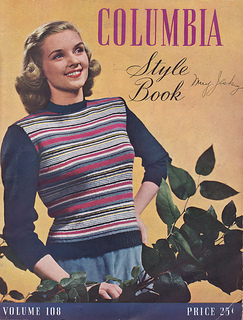
This is "Versatile" from the 1946 Columbia Style Book, vol. 108 (pictured below). I like to imagine that the model in the photo on the right is dreaming about what it might be like to wear this sweater against a background of a grill, a yard-waste bucket, and a dog. Answer: it's pretty sweet. I'm fairly mixed in my opinion of the finished project. I like the shaping and style of the sweater, but it's just a little too big on me for complete satisfaction. It's tough to see in the photo, but it's a little baggy along the side seams and so doesn't quite have the same sleek glamour as the original photo, though I have successfully worn it a few times.

So, it's time for my official 1940s project for this current challenge. We're now solidly into the realm of fine gauge, fingering weight sweaters. I skirted the issue for a little while in my earlier decade sweaters. When no gauge is provided and you have to reverse calculate a stitches-per-inch figure using the original stitch numbers in the pattern and your own body measurements, you can get away with using a heavier yarn that the pattern writers probably intended. But, once we hit the 1930s and '40s and yarn companies started adding in those helpful details (like gauge and needle size and modifications for different finished garment sizes, etc), it's harder to avoid those skinny yarns. Don't get me wrong: I absolutely love the look and feel of a lightweight sweater knit on size 2 needles, but they do tend to take a little longer to make.

I took a leisurely browse through my 1940s booklets and identified a few potential projects.

Name, Please! Can you say "bombshell" with that partial zipper and deep V-neck? The embroidered initials seem so much a hallmark of the era, too.
A Little Something on the Side. I adore the off-center buttons and almost military styling of this otherwise simple cardigan.
Lumberjacket. So practical for work or housework. The tiny buttoned pocket and collar are great features, too.
Block Cable Cardigan. There's something about those interrupted block cables that looks so vintage and cool to me. And I really like the zipper and peplum.
Remember my personal goals for this project from a couple posts ago? When I said that I wanted something made of a natural fiber, ideally without buttons and miles of crochet finishing? Ha! It's true that all of these can easily be made with wool and there is not much, if any, crochet edging in them, but look at all those buttons! And the ones without buttons have zippers!! Well...two out of three ain't bad.

I love that all four options have crisp lines and a fitted structure. I also like the menswear inspired details, like the collars, the buttoned pocket, and the off-center buttons. All look very '40s. I polled my friends and early results showed a clear preference for "Name, Please," although "A Little Something on the Side" had a great late boost and probably would have won if I hadn't already decided to go with "Name, Please," which was published in Sweatertime: Around the Clock by the Oregon Worsted Company in 1942. My copy of this booklet was given to me by a friend who found it in a stack of other patterns out with the recycling.


I've chosen a gorgeous Maine yarn for my "Name, Please;" it's JaggerSpun sock yarn in raw umber (I absolutely love it). I toured their Springvale mill recently and thoroughly enjoyed learning about the spinning process. The staff was so very kind and informative. I highly recommend a visit if you can get there. If not, grab some yarn when you see it around. I think you'll really like it. This is entirely my own honest opinion. I haven't been paid in either yarn or money to say such things.

And so, I'm off! My size 2 needles are clicking away. 

06 March 2017

Accepting the torch

Most of my friends and family members know that I collect old knitting patterns and they keep a good eye out for me. One time, a friend found a stack of 1930s and '40s booklets out with the recycling on a sidewalk and grabbed them for me. There were some gems in that stash for sure (more on that little collection when we get to my next project), including a single solitary cover of a fabulous Vogue Knitting magazine from the 1950s. Just the cover though. It was such a disappointment to discover that there were no pages attached.

A few weeks ago, another friend alerted me to a "free for the taking" ad on Craigslist promising a stack of 1950s and '60s Vogue Knitting mags, among other vintage booklets. Of course, this meant that I might be able to expand my Vogue Knitting collection beyond just the cover page that I then had in my stash. I saw that the ad had been listed for several weeks, panicked slightly, thinking that naturally someone else would have claimed the lot in the meantime (in my mind, of course, there's hot competition for old instruction booklets), and emailed the poster immediately. I sent along a link to my blog, explained the project, and hoped that I might be able to take home the mags. She wrote back right away and said that I could have them, adding that her mother would have thought the project a great idea.
That little comment was meaningful to me and clued me in to a couple of things. This wasn't an ad posted by someone looking to get rid of a few things that had randomly turned up in the attic. These books belonged to someone in particular. That someone was a knitter and these formed part of her stash. And knitters' stashes are personal. These points became even more clear when I met the poster, who described her mother to me as a "fearless knitter," someone who had traveled the world, become an accomplished artist, and knit dozens of garments for herself and her family. She showed me to the promised stack of knitting magazines and invited me to take a peek at them and several others that were not included in the original listing, including a long run of the Italian needlework magazine Rakam. There were bags of yarn on offer, too, and a sweet painted wooden lady (a wall hanging) with jointed arms and legs and a mini knitted swatch in her hands.

The stack.
It was great fun to look through everything and I ended up with a stack of booklets and magazines, one bag of wool, and the little wooden lady, who will be cute hanging up near my knitting supplies. At the same time, it was lovely to be able to learn about this other knitter and, figuratively speaking, take up her knitting needles.

I always feel this way when part of someone else's stash is added to my own. Joining their magazines or yarn to mine brings with it a sense of responsibility. I feel inspired to honor their creativity and curiosity. Passing the torch in this way keeps the craft alive and vibrant, keeps its roots visible, maintains my connection to generations of knitters going back over the years. Of course, it's easy to feel this way when I pick up a pattern book that belonged to my grandmother, but I feel it, too, when I knit with yarn that belonged to a friend of a friend who has passed away or when I take a look at some of these fabulous mid-century suits and dresses in my "new" Vogues and wonder if their previous owner ever made one.

Incidentally, it turns out that she did indeed make dresses and other similarly impressive feats of knitting. I was lucky enough to be able to take one of these incredible garments home. And it even fits! It is a truly fabulous full-length, high-necked, long-sleeve Fair Isle dress made of the gauziest mohair in luminescent greens and blues. It is incredible. It is all hand made. And it is super warm. I love it. There is just so much knitting and care and work in it. My apologies for the slightly blurry photo; I'd like to think that part of it is due to the halo of the mohair, but it's more certainly due to the fact that I am standing on tiptoes to show the full length of the skirt. Without my shoes on, I'm just a little too short!

I'll have details soon on my next knit from the 1940s. And hopefully some preview pictures of possible 1950s projects from my new Vogue Knitting magazine.