Showing posts with label buttons. Show all posts

20 February 2017

1930s: Complete


Well, I didn't get the pose just right and I didn't have the appropriate statement necklace, but my 1930s metallic cocktail jacket is complete! I'm thrilled. Not only is it a great feeling to have finished what has been a painfully slow project, it's also a welcome break for my hands and fingers. The metallic yarn was harsh on my skin and the matte gray yarn was splitty and annoying, but it was all worth it. I love the result. The puffed sleeves, the metallic smocking, the solid yoke...a great 1930s look.

And I'm pleased with the fit, too. It's close-fitting and tailored without being too tight, the sleeves are well-engineered, and the buttons work without too much gapping.


The pattern was solid, too: clear, detailed, well-written, and mistake free. I made just a few modifications, including adding 2" to the overall length and reducing the number of cast-on stitches for each front from 63 to 50. My gauge was just a little larger than recommended and, after knitting and measuring the back, it was clear that I'd need a few fewer stitches to do the job. I'm glad I did. Sticking with the original instructions would have led to a sweater that was a bit too big. Other than those two points, I changed nothing!

Construction-wise, this was a pretty standard knit. One back, two fronts, and two sleeves, all knit from the bottom up. The seams were easy to sew and the busy surface design means that the seams are virtually invisible despite mismatched patterns on the different pieces. Just like my first two decade sweaters, there is a lot of crochet finishing in this. The sleeves, neck, fronts, and lower hem are all finished in a few rows of single crochet. In fact, the buttonband and buttonholes are done in crochet. So, that took a long time, but it does provide nice stability to the edges and a polished finish. I chose simple black hemispherical plastic buttons and I think they're just right and in keeping with the original pattern recommendations.


The next step for this sweater is to find somewhere to wear it! I'll be delving into my 1940s pattern books next to see what I can find. After this one, though, I have a few personal goals for my next project:

1. Must be made of a natural fiber.
2. Maybe no buttons for a change?
3. No crochet edging!

Specs
Yarn: Massive mystery skein of dark gray cotton (?) and cone of silver metallic synthetic
Amounts: I still have a lot of each left
Needles: size 2
Crochet hook: necessary, but I don't remember the size
Started: 2 October 2016
Finished: 19 February 2017

19 March 2016

First Decade Down


One decade down, 9 more to go! My 1907 Ladies' Outing Coat is finished, just in time for a cooler-than-normal early spring day, and I'm pretty pleased with the results. It is perhaps a shade too big and doesn't have quite the same hourglass shape* as the picture, but, overall, this sweater is warm, comfortable, and looks just fine with jeans while retaining its early-20th-century charm. 

* I know that the hourglass shape in the picture is enhanced by a corset and that this sweater was undoubtedly intended to be worn with one. I do not intend to do this. 

 
 Since my last progress post on this sweater, I've knitted and attached the second sleeve, knitted and attached the two pockets and the collar, crocheted about a mile of edging and buttonholes, and attached 14 buttons. A warning to all who might be contemplating adding this sweater to the queue: it is not for the crochet-averse knitter. There is a lot of crochet edging in this project. I'm certainly not the world's most confident crocheter (that would be my sister-in-law Melanie), but I feel pretty good about adding crochet borders to knit projects and I sort of love that this pattern just assumed I could do both needlecrafts with equal competence. Plus, since this was a fairly straightforward single crochet edging, I knew I could handle it, even if it did take quite a lot of time. The buttonholes are built into this crochet edge and, since you're working at a fairly tight gauge with the yarn held double, they are quite sturdy and stable. Overall, I think the crochet border adds a nice finish to the sweater and really stabilizes the sleeve cuffs, collar edging, and lower hem. A ribbed garment like this will naturally have a tendency to stretch and the crochet works well to counteract that tendency.


There was almost no detail in the pattern about attaching the buttons, so I went with my instincts and placed 4 buttons on each side of the front. In order to achieve the fit I wanted, I had to place the buttons somewhat further apart than they appear in the pattern picture. I also had to come up with a plan for the hidden inner buttons. I used black buttons for exterior surfaces and white buttons for interiors.


I ran into some trouble with the "revers" (the folded-back lapels). When I placed the buttons where I wanted them, I found that I couldn't really fold back the top edges and keep them even and centered like the pattern photo showed. So, I decided to skip those top buttons and leave the outer lapel loose as you see below. I think it still captures the look of the original.


I found some vintage-style buttons at Jo-Ann that I used for the pocket buttons. These were labelled as 1890-1910, perfect for my project! The pockets themselves are knit separately and sewn onto the fronts.


I'm already looking forward to delving into my 1910s patterns!

Specs
Yarn: Knit Picks' Wool of the Andes sport weight, about 14.5 balls
Needles: size 4 
Crochet hook: Crochet hook sizing confuses me. The one I used said "4 or E"
Started: 16 January 2016
Finished: 19 March 2016


14 March 2016

Meanwhile...

I couldn't resist sharing a few things I discovered on a recent jaunt to some of southern Maine's antique malls. I picked up two vintage pattern booklets. One from 1939:


It's full of fabulous sweaters and some pretty wonderful photography. Some photos feature everyday scenes, like this one (love the kerchief):


Others are somewhat stranger, like this elegant woman with her super-sleek hair and sweater and that incongruous bunny. I think the designers were trying to make a point about the angora yarn used in the sweater, but I'm not convinced that it was the right call.


I also found a booklet of small projects from 1942. There are items for everyone in the family, from lacy collars and bedjackets for Mom to sweater vests and socks for Dad and plenty of projects for the kids, too (think stuffed dolls and woolly accessories).


I also nabbed a couple of magazines from the 1950s:


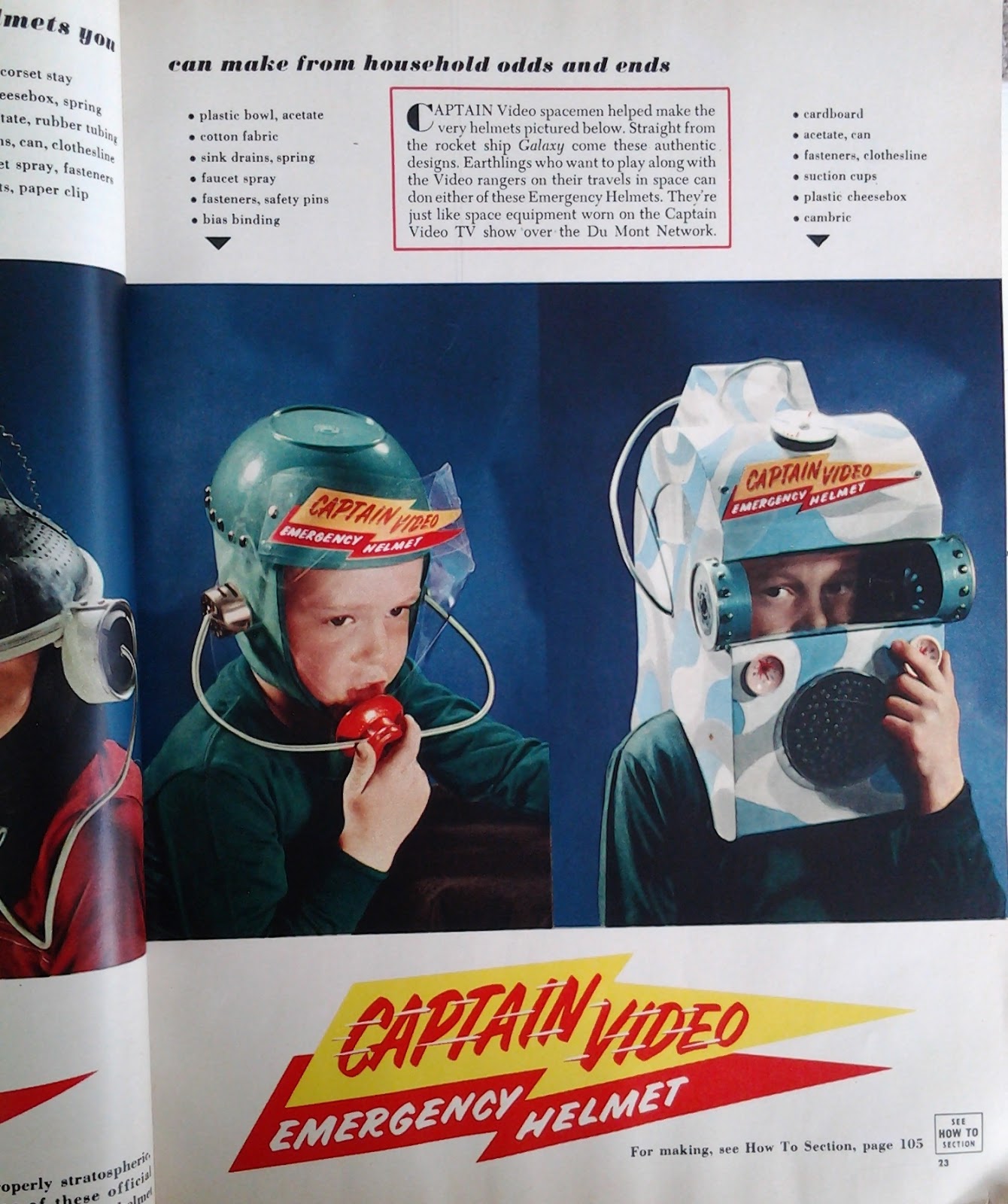
Woman's Day dates to August of 1953 and Modern Needlecraft is from Fall 1956. This particular issue of Woman's Day does not have many knitting patterns, just a three-way interchangeable sweater set, but it is absolutely full of articles about cooking, home design, and fashion as well as ads, which are fascinating themselves. I find it so interesting to look through magazines like this with an eye to their design and layout. This sort of mundane, ephemeral history is so rich in detail. I especially enjoyed the article entitled "Will Your Child Visit The Moon?" and its accompanying instructions for making space helmets out of everyday household items:


Crafters could cut out the logo at the bottom of the page and paste it to the finished helmet, which would most definitely have taken a lot of time and patience (and glue!) to make. The construction diagrams in the "how-to" section are more like engineering plans than craft instructions.

As an aside, did you know that Woman's Day was the official store magazine of the A&P? I did not until I looked through this copy. That explains the abundance of grocery-related ads and the inexpensive cover price of 7 cents. According to Wikipedia, the magazine was first sold in stores in 1937 and had a circulation of 3,000,000 by 1944 and 4,000,000 in 1958 when A&P sold the magazine to Fawcett Publications. It was sold a few more times and, of course, is still published today. There's a little history to consider next time you're waiting in the check-out line at the grocery store.

In contrast, Modern Needlework has a fifty-cent price and is loaded with knitting patterns for everyone, even the dog. I especially love this ad on the inside front cover. Look at that pair! Those stripes! That skiing sweater!


My last find was a card of unused vintage wooden buttons with a great Art Deco feel. I'll stash these away until I reach the '30s, I think.