29 February 2016

The view from Sleeve Island


This is why I so often knit short-sleeved sweaters: they do not require any sort of extended stay on Sleeve Island. If you're not a knitter, you should know that Sleeve Island is the mostly imaginary and frequently-visited place where we knitters go when we are elbow deep in sleeve knitting (see what I did there?). It's barren and lonely, and, in my case, very gray. You see, sleeves are wide and they are long; they are time consuming and they come in pairs. They make you think that they are just narrow tubes of fabric that will take no time to make. After all, you've already completed the front and back of the sweater, so most of your body is already covered at this point. The sleeves are basically afterthoughts, right? Wrong. Always so wrong. Sleeves are deceptive. Sleeves are cruel. They start narrow for the cuff and just get wider and wider. And then you have to make a second one.

Fortunately, for the 1900s knitter, designers were a little more sensible about sleeves. In the case of my Ladies' Outing Coat, the sleeve pattern starts at the top and decreases down to the cuff. This not only makes for a more pleasant stay on Sleeve Island, but also seems to offer more options for ensuring that the sleeve is the proper length. You can try it on as you knit and, if it ultimately ends up the wrong length, it's much easier to rip out a cast-off row and add or subtract length than it is to fiddle around with the cast-on row and do the same. With that said, though, I am trying to power my way through this first sleeve. It's still slow going, but, once it's done, I'll attach the sleeve and seam up half the sweater and see how things are fitting so far.

In the meantime, I've been thinking more about 1900s fashion. My 1907 pattern book is full of patterns for women on the go: they are fishing, riding horses, studying, traveling in automobiles, golfing, and sailing. It's fabulous.

Cable-stitch Sweater from The Columbia Book of Yarns, 1907
Columbia Knitted Blouse Jacket from The Columbia Book of Yarns, 1907

The S-curve silhouette and attendant smooth, puffed-out breast are still very present, but I think these designs express a nascent shift in womenswear, one that would allow for more comfort and freedom of movement, especially as increasing numbers of women took up hobbies like cycling and lawn sports. This era was one of great change in women's undergarments, too, as heavily-structured corsets gradually gave way to brassieres and lighter-weight corsets. There's a fascinating read on the Victoria and Albert Museum's website about the evolution of corsets in the early 20th century. I love that knitwear seemed to be able to offer women this greater ease of movement while also keeping up with contemporary trends in fashion designs and silhouettes.

In related news, I acquired a few new-to-me vintage pattern books over the weekend and am pretty sure I have my 1980s sweater picked out. I love it. But no spoilers for you.

24 February 2016

Where are the mistakes?

Every time I knit from a vintage or antique pattern, I prepare myself to run into lots of mistakes in the pattern itself. Of course, not every vintage pattern is riddled with errors, and there are plenty of contemporary patterns that are full of them. Personally, I think this cautious sentiment stems from looking though mid-19th century pattern books, which so often contain a disclaimer that, although great care has been taken to prevent mistakes in printing, there will necessarily be some errors and that it is the knitter's responsibility to find and correct them. The publisher basically takes no responsibility for the home knitter's bad results from error-filled patterns. That doesn't exactly fill one with confidence.

So, I've always just expected mistakes. I look at each measurement, stitch count, and decrease with great suspicion. I do all the math. I count all the stitches. I interrogate each instruction. And if I don't find mistakes in a particular pattern, I start to doubt myself, as if I've overlooked something obvious if I haven't spotted an error. So far, my Ladies' Outing Coat instructions have been error-free, which has inspired in me a fair amount of distrust. Where are the mistakes? Have I missed them?

Fortunately, I worry no more. I have found some mistakes and weird math in the sleeve instructions (wahoo)! I have the strange sensation of feeling both confident and trepidatious: I found the mistake (all is right with the knitting world again), but now I'm concerned about the outcome of my sleeve. The pattern calls for a cast-on of 50 stitches, followed by increases of 2 stitches on both ends of the needle every other row until there are 100 stitches total; this forms the top of the sleeve. This is impossible since 50 is not divisible by 4 (haha! mistake! I knew you'd turn up). It also seems doubtful that the pattern would be uneven in this way, so I decided to work until I had 102 stitches. I considered the possibility that the mistake was something more than a simple typo, but the sleeve cap seems to look right so far. So, on we go.

In thinking about this mistake, I did also check a couple other sources for solutions. Unfortunately, no one has posted projects from this pattern on Ravelry yet. I wondered if later editions of the Columbia Books of Yarns might have the same pattern with updated instructions, but my search didn't turn up any later versions.

19 February 2016

So much for Rule 6

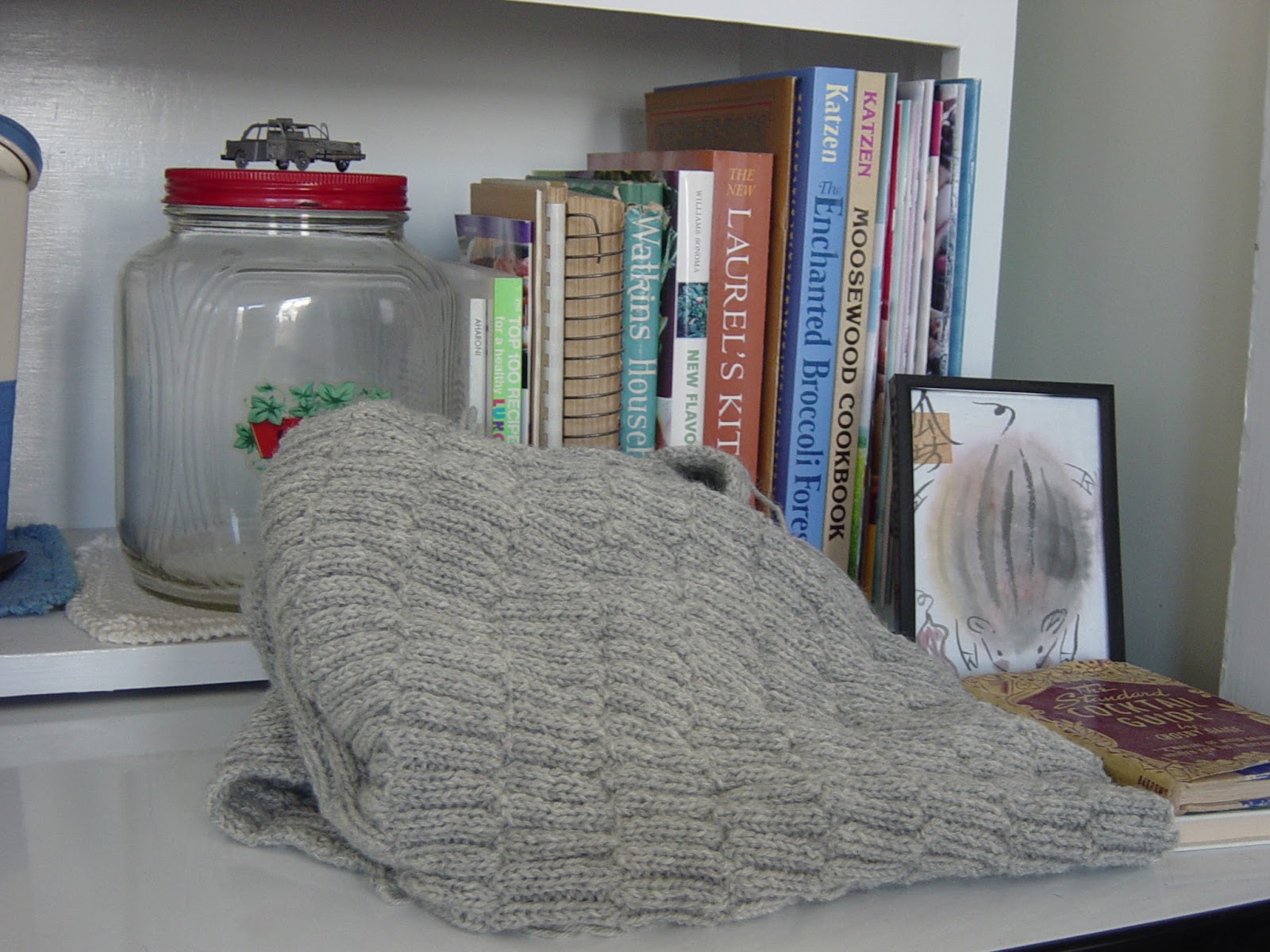
I swear I would have posted progress reports sooner...if I had felt there was anything interesting to share. Since the back and fronts of this sweater are knitted all in one giant piece, my sweater-in-progress hasn't looked like much more than a pile of gray 2x2 ribbing since I cast on. Here's a picture to prove it. I put it in front of my Hoosier for scale and interest, but you can still clearly see that it's a big ol' pile of nice gray wool.


And here it is piled up in a slightly different way:


That being said, though, there are some interesting things going on in the construction of this sweater that make it quite different from contemporary patterns. Once knitted, the back looked extremely narrow to me, but as I got going on the first front, I realized that the width of the underarm area is cast onto the front only, which means that the fronts end up much wider than the back. Additionally, the fronts include a deep overlap for the double-breasted construction.

Here's the sweater laid out with the side edges folded under, as if the side seams were sewn. You can see the overlap and height of the center front.


And here it is with one front open and the full underarm width visible:


You might also notice in these pictures that the fronts both have some short-row shaping at the lower edge. The underarm length is left the same as the back while the center panels are about 1.5" longer. I suppose the shaping adds a tailored appearance to the jacket.

Onwards to the sleeves!

28 January 2016

Casting On

I took the plunge.

I cast on 114 stitches for the back (the original pattern calls for 100). How I came to that number, I'm not entirely sure. I had written down a few numbers and an equation on a piece of paper next to my swatch, but when I went over my calculations again, it didn't make as much sense.  I was going to include a full and detailed explanation here, but I don't think I can anymore.

The back seems a little small, but each front is much wider than half the back, so there's hope. Enough hope that I will keep knitting. And crossing my fingers.

23 January 2016

The Ladies' Outing Coat, and a little math

Although I was tempted by the Ladies' Outing Jacket and its seaworthy model, I've settled on the Ladies' Outing Coat from the 1907 edition of The Columbia Book of Yarns. I like its smart double-breasted buttons, puffed sleeves, and fitted silhouette. Unlike the Jacket, with its hem and belt at the natural waist, the Coat is longer and more suitable to my current wardrobe. I could absolutely see myself wearing this with jeans or a skirt, as an outerwear garment or as a sweater.


The pattern is fairly complete in its instructions, with clear descriptions of stitch pattern and construction details, but, typical for patterns of this vintage, is lacking information about gauge. Fortunately, it is written for a 36-38" bust and does include directions for increasing and decreasing the size. Since I want to make sure that the finished product fits as well as possible, I read through the pattern several times and sketched a schematic, filling in the provided stitch counts, decreases/increases, and lengths so that I could clearly see the proportions and sizes of different parts of the pattern. The sweater's back and fronts are knit in one giant piece (no shoulder seams to sew), with some waist shaping and built-in increases for the overlapping double-breasted fronts with folded-down lapels (or revers, as the pattern calls them).

I took my own measurements (36" bust, 28" waist, 36" hips), considered ease and fit requirements (there should be negative ease in the finished piece), and pulled out a (roughly) similarly-shaped sweater that has a fit I like. The overall length of the Outing Coat is 20.5", which matched my existing sweater and so should work just fine. The next step was to calculate my desired gauge and check if the stitch counts at various stages of the pattern would work for me and, if not, figure out what they should be.

So, I knit a swatch in the "reversed rib" pattern of the Coat. I chose Knit Picks' Wool of the Andes sportweight and size 4 needles as a starting point (mostly a guess, at this point). The stitch pattern is an alternating 2x2 rib, with each repeat happening every 22 rows. The resulting swatch, as expected, was super stretchy, which is a big part of the fitted look of the finished garment. I washed and blocked the swatch. Once it's dry, we'll see what it tells me about the next steps!


10 January 2016

Into the 1900s!

According to the (super nerdy, but oh-so-satisfying) Excel spreadsheet database of my vintage pattern collection, I have just about 260 individual titles, ranging from single patterns to pamphlets to full magazine issues. Unfortunately, this includes only one publication from the first decade of the 20th century: the October, 1905 edition of The Delineator magazine.

My copy is missing its cover, which I'm sure was fabulous.
It's a fascinating read, with articles covering everything from autumn millinery and new styles in mourning attire to modern house building and techniques in housewifery (including how to make Hallowe'en party centerpieces and new recipes for celery novelties). The ads, too, are richly evocative of the fashions and household concerns of the day (and, really, aren't too different from those of today): the best-fitting underwear, the most reliable watches, the healthiest baby food, the purest soap, and the most fashionable shoes.

From The Delineator, October 1905
Tucked in amongst the wide-ranging articles and ads are a couple of knitwear patterns: one for a young girl's Norfolk jacket and another for a dog's sweater. Both are delightful, classic designs that would absolutely work for today's young girls and small dogs, but are not especially suited to me (or my dog).

Dog sweater from The Delineator, October 1905
Young girl's Norfolk Jacket from The Delineator, October 1905
And so I turned to the array of 1900s patterns available online. Many are in the public domain now and easily accessible. I browsed the selection on archive.org and on the Antique Pattern Library and settled on the 1907 edition of The Columbia Book of Yarns by Anna Schumacker. This volume offers clearly illustrated descriptions of the various needles, hooks, and techniques of both knitting and crocheting and also provides readers with photos of new stitch patterns as well as many of the finished garments. I especially love the inspirational sayings at the bottom of each page: "Knitting is one of the most soothing occupations a woman can indulge in" and "Inferior yarns are dull and lifeless. Columbia Yarns are brilliant." The introduction, too, remains so timely and topical:

Knitting was once every woman's duty. Now it is her pleasure, her relaxation, her nerve-soothing occupation for leisure moments in a busy life. With the growth of the various arts and crafts movements, knitting, like all handwork, has taken on a new dignity; and the increasing use of fine yarns gives it new possibilities of beauty.

A flip through a few pages takes you to the women's patterns, with their nipped-in waists, high necks, and puffed sleeves. I admire the Ladies' Outing Coat on page 126 and the Ladies' Outing Jacket on page 132 and I think both would be quite wearable today. Let me dive into the patterns and see how they come together.

05 January 2016

Rules, Regulations, and an Intro

Some Background: I've been knitting since I was a girl and learned the basics from my grandmother. I picked it up again in earnest during high school and college and haven't stopped since. My collection of vintage and retro pattern booklets started with my grandmother's stacks of patterns from the 1940s through the 1990s; many of them are full of her own project notes and ideas. Now, I enjoy hunting down other booklets at antique stores, yard sales, and estate sales. I love the styles in these books, the photography and graphic design, and the language. Some of the featured pieces are timeless and others are firmly rooted in their own era, for better or worse. I can't wait to explore them in a more tangible and woolly way!

The Goal: To knit one sweater from each decade of the 20th century, starting with the 1900s and ending with the 1990s, in an effort to enjoy and use more of my collection of vintage knitting patterns and to learn about past styles and techniques.

The Rules
  1. I pledge to adhere as closely as possible to the original pattern, making modifications only to ensure the fit of the finished garment and/or to correct misprints or errors in the original pattern.
  2. Whenever possible, I will work from a physical pattern already in my collection.
  3. Each project will be a sweater.
  4. This is selfish knitting: all ten sweaters will be for me.
  5. There is no time limit.
  6. I will blog at least once a week about the whole process: from pattern selection and prep work to the knitting and finishing process. 
  7. I reserve the right to work on other projects in between my Century Sweaters.
  8. My knit-friendly husband may post about the process from his perspective as well. 
Follow my progress here. Onwards to the 1900s!